



How to choose a Go board
For all Go board products, please click here.
For Board craftsman Mr.Torayoshi Yoshida made Go board, please click here.
For Board craftsman Mr.Keiji Miwa made Go board, please click here.
For Board craftsman Mr.Miura made Go board, please click here.
For Go board with legs, please click here.
For Table Go board, please click here.
For Other Go boards such as miniature board, 9*9-ro Go board, Off-spec Go board, etc, please click here.
There are a wide variety of Go boards with a wide range of prices.
The price ranges from a few thousand JPY (less than US$100) to over 10 million JPY (US$100,000), so we recommend that you choose a board that fits your budget, the situation in which you will be using it, and your personal preferences.


Value and Price
Materials

Hyuga Clam Shell
Mexican Clam Shell
Glass, ceramics, etc.
Plastics, etc.
Mexican Clam Shell
Glass, ceramics, etc.
Plastics, etc.
High
Low

Nachi-Kuroishi from Kumano City, Mie Prefecture
Other Domestic Black Stones
Foreign black stone
Glass, ceramics, etc.
Plastics, etc.
Other Domestic Black Stones
Foreign black stone
Glass, ceramics, etc.
Plastics, etc.
Quality
In the case of white Go stones made from clam shells, it is very difficult to produce Go stones without flaws or colors, because there are flaws originating from the material, or flaws are caused in the manufacturing process, or the color of the material remains. In addition, our Go stones have an ideal Go stone shape for each size. Any stones that deviate significantly from this ideal shape are excluded from our products. In the case of Nachiguro Black Go stones, there is no difference in quality compared to Clam White Go stones because there are no stripes and the quality of the material is stable.
Premium grade
Almost flawless Go stones
All of our Go stones, white and black, are selected by our craftsmen for quality. Go stones with almost no flaws are classified as "Selected" grade.
Blue label
Go stones with slight scratches and color remaining
Go stones that have been carefully selected but still have slight flaws and color are classified as "Blue Label" grade. Go stones that do not meet the Blue Label standards will not be commercialized.
Grade
Clamshell White Go Stones Stripe Rank
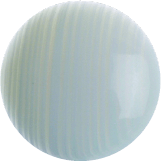
Snow grade
Top quality (approx. 5-10%)
The grade of Clamshell White Go Stone is ranked by the stripes of the Go Stone. Clamshell White Go stones have stripes on one side of the stone (some stones have a little stripe on the other side). The side with stripes is called "Omote" and the other side is called "Belly". The more stripes on a Clam White Go stone, the thinner the stripes themselves are and the straighter and narrower the distance between stripes, the more beautiful and valuable the Go stone is.

Blossom grade
Grade (stripe) is less than Snow grade
Only clamshell White Go stones with more than 80% of the total stripes are the highest grade "Snow grade". Because only about 5 to 10% of all clamshell White Go stones are produced, "Snow grade" is a very rare and relatively expensive clamshell White Go stone. Striped Go stones that do not meet the "Snow grade" grade are classified by quality as "Premium Blossom grade" for stones with almost no flaws, and "clamshell Go stones Blue Label" for stones that were not selected carefully but still have slight flaws and color.
Size (Thickness)
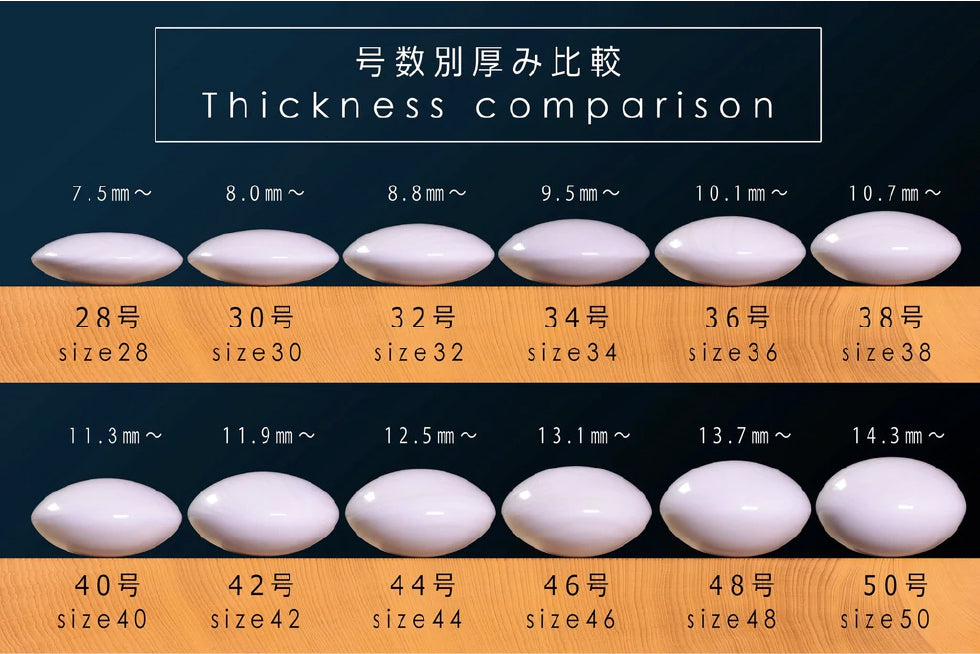
The thickness of Go stones (Clamshell White Go
stones and Nachikuro Black Go stones) are standardized from size 20 to size 50. Clamshell white Go stones are made from natural clam shells, and since only a small number of thicker shells can be obtained, the thicker the Go stone, the more expensive it is. Normally, we sell 12 types of Clamshell Go stones in even numbers from size 28 (7.5mm) to size 50 (14.3mm).
The thickness and diameter of our Go stones are slightly different between white Go stones and black Go stones of the same size. The thickness of Nachikuro Black Go stones is 0.3mm thicker and the diameter is 0.3mm larger than Clamshell White Go stones of the same size.
The thickness and diameter of our Go stones are slightly different between white Go stones and black Go stones of the same size. The thickness of Nachikuro Black Go stones is 0.3mm thicker and the diameter is 0.3mm larger than Clamshell White Go stones of the same size.
The standard diameter of the Clam White Go Stone is 21.9 mm, while the diameter of the Nachi Black Go Stone is 22.2 mm.
The reason for this is that white is an expansion color, so when white and black stones of the same diameter and thickness are viewed by the human eye, the black stones appear slightly smaller, so they are adjusted to appear about the same size. If the black stones look smaller on the board, it would seem psychologically disadvantageous, so the stones are adjusted so that they appear to be about the same size to the human eye.
The reason for this is that white is an expansion color, so when white and black stones of the same diameter and thickness are viewed by the human eye, the black stones appear slightly smaller, so they are adjusted to appear about the same size. If the black stones look smaller on the board, it would seem psychologically disadvantageous, so the stones are adjusted so that they appear to be about the same size to the human eye.

How to choose Go stones
For all Go stone products, please click here.
For Premium Go stones products, please click here.
For Clamshell Go stones BLUE Label products, please click here.
For Go stones Care Kit products, please click here.
There are two types of Go stones: white Go stones and black Go stones.
White Go stones
The most common white Go stones are Clam Go stones, which are made from clam shells. In addition to Clam Go stones, there are also glass and plastic Go stones.
Black Go stones
The most common black Go stones are Nachi-Kuroishi from Kumano City, Mie Prefecture. In addition to Nachiguro stones, there are also stones made overseas, glass, plastic, etc.
Recommendations for those who have seen this product
Recently viewed
関連商品


